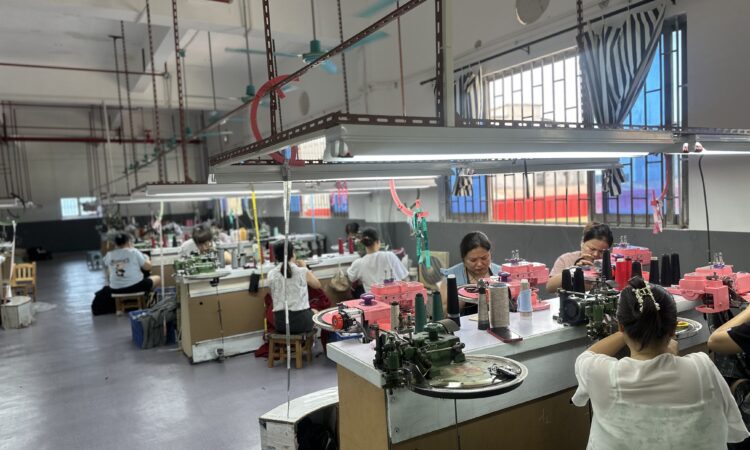
In China’s Dongguan, Guangdong, there is a magical town with a total area of less than 120 square kilometers. One out of every five sweaters in the world comes from here.
This is Dalang Town, known as the “World Capital of Knitting.”

This small town has nearly 30,000 knitting and spinning enterprises, employing a workforce of 200,000 people.
Today, Dalang’s knitting industry is transitioning from a “sweat economy” to a “smart economy,” creating the “Dalang speed” in the knitting world.
Since the establishment of the first woolen fabric factory in 1979, Dalang Town has formed a complete ecological chain covering woolen fabric R&D design, intelligent manufacturing, and brand marketing, and is jointly building the “World Woolen Capital” with the China National Textile and Apparel Council.
Currently, the town produces 900 million sweaters annually, with 28,000 woolen textile enterprises striving for faster speeds every day.
In recent years, the “small-batch, rapid-response” model in the apparel industry has significantly strengthened the emergency production capabilities of wool textile enterprises in Dalang Town. This has driven the proportion of domestic sales orders from less than 10% two years ago to nearly 20%, effectively offsetting the negative impact of declining export markets.

Meanwhile, relevant authorities in Dongguan have been actively assisting enterprises in streamlining trade procedures and boosting export efficiency.
In recent years, the emerging “one-stop garment manufacturing” technology has quietly taken root in Dalang Town.
The domestically produced integrated weaving machines here now match the speed of imported models, yet are priced at less than one-tenth of their cost, making them highly sought-after in the market.
Currently, domestic models account for 80% of the integrated weaving machines used by wool textile enterprises in Dalang Town,